King Henry IV
Henry IV, Part 2King Henry IV’s kingship is presented as both an office that must endure and a burden borne by a vulnerable, failing body. His sleeplessness, the continuing reports of rebellion, and his final acknowledgment that he must answer to God for how he gained the crown converge around the succession to Prince Henry: the crown can pass to a new ruler, but the history and moral weight attached to it do not simply disappear.
Kingship under strain
At Westminster, King Henry IV appears in his nightgown, unable to share the sleep available to ordinary subjects. He thinks of the many thousands of his poorest people asleep while he remains awake, and addresses sleep as a gentle nurse he has somehow frightened away. The contrast is political as well as bodily: even the wet sea-boy can rest through a rough hour, while a king in a calm night, with every comfort available, is denied repose. His conclusion, “Uneasy lies the head that wears a crown,” makes sleeplessness the intimate cost of rule. The crown’s authority does not protect the person who wears it from anxiety; instead, it marks him out from the sleeping realm he governs.
That private distress unfolds amid continuing public danger. At the opening, Rumour runs ahead of King Henry IV’s victory at Shrewsbury, where Harry Percy and his troops have been beaten. Morton, arriving from the same field, describes death as having appeared in its ugliest form to frighten his party. The different reports make victory visible through the fear and violence that accompany it, rather than as a bloodless declaration of secure authority. Nor does one defeat end the threat: the Earl of Northumberland and Lord Bardolph, with a large force of English and Scots, are later reported overthrown by the sheriff of Yorkshire. The king’s reign is thus shadowed by successive challenges and the need to learn of them through reports brought from elsewhere.
A contested political past
The play places King Henry IV’s rule within a history of relationships and allegiances that can change quickly. Warwick recalls that Richard II and the Earl of Northumberland were great friends less than ten years earlier, and observes that every life contains a history that reflects the character of its times. This retrospective perspective gives the king’s political present a longer horizon: the alignments visible in one moment are not permanent, and the consequences of past changes of allegiance remain active in the present.
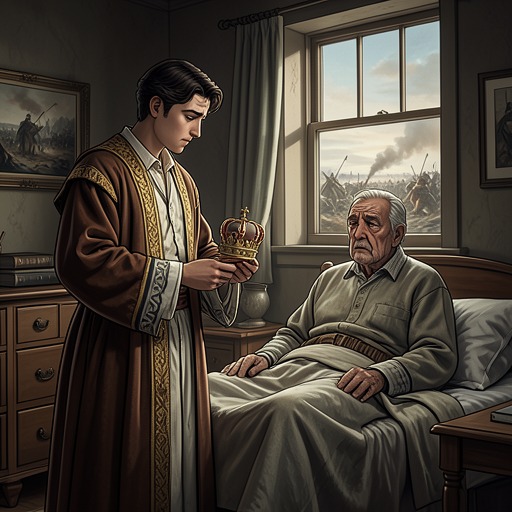
The succession intensifies that history. Alone beside his father, Prince Henry sees the crown lying on the pillow and regards it as a troublesome bedfellow. He then declares that Harry the Fifth is crowned and calls for royal state and its counsellors to depart. The language marks a decisive transfer: the king’s authority is no longer merely a matter of the old ruler’s physical possession of the crown, but an office the son can take up and publicly name as his own.
Father and son at the bedside
When King Henry IV learns that Prince Henry has taken the crown away, he does not read the act as simple seizure. He thanks God for putting the thought into his son’s mind and interprets it as an attempt to win his father’s love through a wise explanation. That interpretation makes the bedside scene at once political and intimate: the crown is the object around which succession turns, but the king also sees in its removal a possible gesture between father and son.
He calls Prince Henry to sit beside his bed and offers what he believes will be his final counsel. The scene’s closeness contrasts with the burdened isolation of the sleepless king: the son who will inherit the office is now physically beside the father whose strength is failing. Yet the transfer cannot be separated from the king’s own past. His lungs are so wasted that he says his strength of speech is denied him, and his final account of the crown is a prayer: he asks God to forgive how he came by it and to grant that it may live in true peace.
The crown and its inheritance
King Henry IV’s ending holds together succession and unresolved legitimacy. Prince Henry’s accession gives the crown a new bearer, while the dying king’s prayer acknowledges that its origin remains morally charged. The father can welcome his son, offer counsel, and hope for peace under the next reign, but he cannot make his own history vanish with the transfer of the object.
The crown therefore connects the king’s natural body—awake, sick, and nearly unable to speak—to a political office that continues beyond him. Its place on the pillow makes that tension concrete: it is a troublesome bedfellow to the prince and, in the father’s final reckoning, a possession whose future peace depends on more than inheritance. King Henry IV’s character is shaped by that double burden: he has won and held the crown, but at the end he must confront the question of how it was won and entrust its future to his son.